
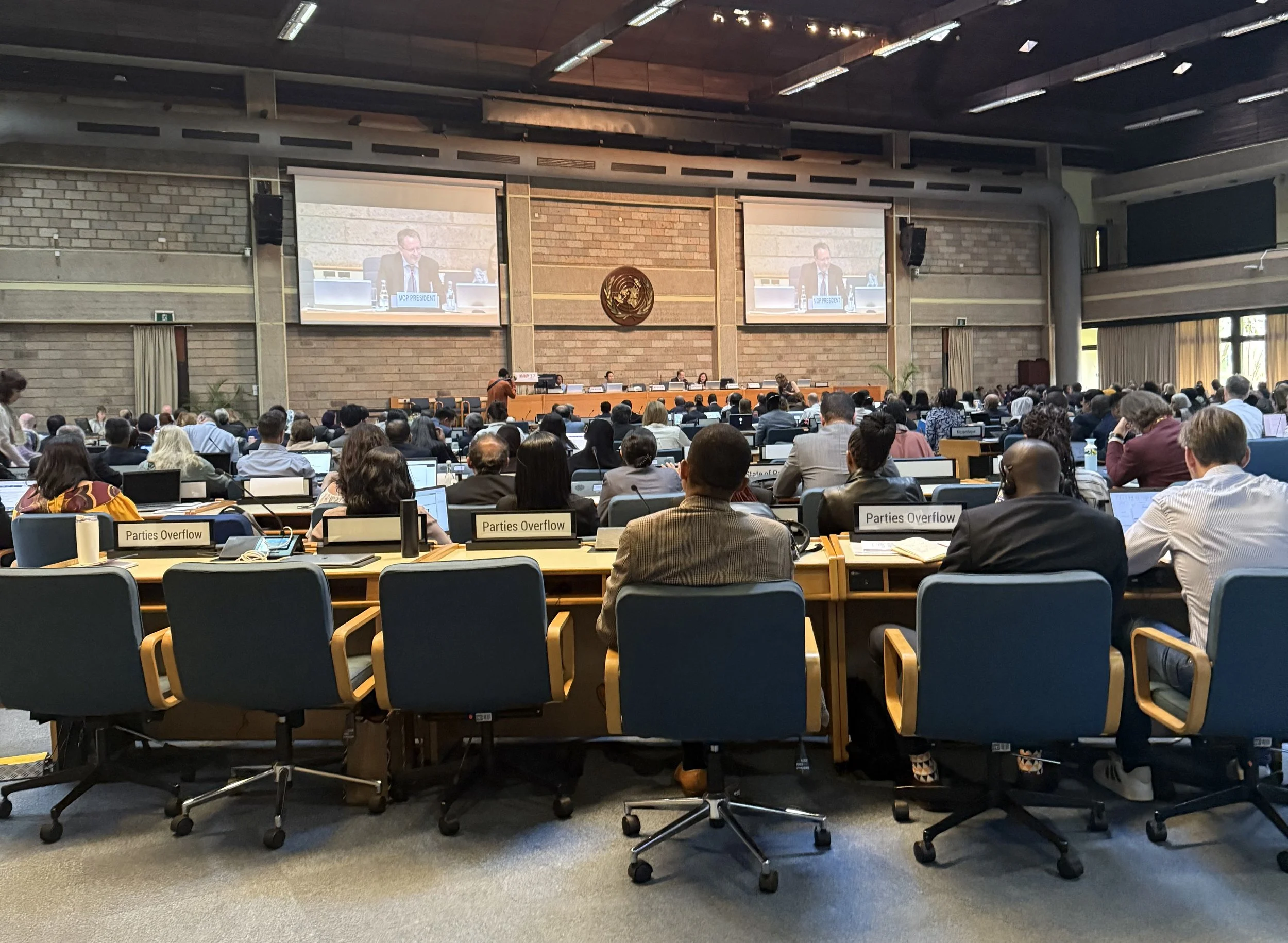
Delegates gathering for discussions at MOP37, where countries worked together to advance protections for the ozone layer and strengthen global cooperation.
The Montreal Protocol continues its powerful progress. I recently attended the Montreal Protocol Meeting of the Parties (MOP). It was an inspiring lesson in global cooperation and effective outcomes. Every country attended, with opening remarks from China, the U.S, Ukraine and Palestine.
A Model of Global Cooperation
It’s a quiet, calm environment: no trade show floor, no celebrities, no private jets and no fundraisers. Just a sequence of priorities guided by scientific and technical findings, engaged in the minutiae of implementation. In feel, it's like a meeting of accountants. It's collegial and, in its mechanisms, egalitarian. Smaller countries are often the drivers of new activity, and their coalitions can be highly influential.
40 Years of Effective Action
The U.S. led the establishment of the Vienna Treaty and Montreal Protocol 40 years ago. Since then, it has put the ozone layer on a path to recovery and, by reducing super-polluting greenhouse gases, established the world's most effective mechanism for reducing greenhouse gas warming.
They meet every year, addressing violations and advancing new actions. Notably, it operates by unanimous consensus. Recently, they extended the treaty to cover substances with strong greenhouse gas effects but minimal ozone impact, the Kigali Amendment, requiring ratification by national governments. The U.S. began this process under President Trump and completed it under President Biden.
This Year's Achievement
This year, the MOP targeted binding action on HFC-23, an incredibly powerful greenhouse gas. There was a holdout, and they had to stay late Friday to bring it across the line, but they reached a decision in time for weekend travel home. These decisions are legally binding and enforced through monitoring.
Quiet Sentinels
In a way, the Montreal Protocol community are the world's sentinels, guarding against particular atmospheric threats. They quietly save us from toasting in unfiltered solar rays, keeping people, and many of our animal and plant friends, safe.
New Challenges on the Horizon
The acceleration of efforts to disperse aerosols in the stratosphere to influence climate, along with growing emissions from air and space activity, is cause for serious concern. The Montreal Protocol was early in providing the world's first rigorous assessment of the potential impacts of these activities on the stratosphere in its 2022 Ozone Assessment. We can look forward to expanded coverage in the 2026 Assessment next year.
A Foundation for the Future
The most successful environmental treaty in human history is built on environmental monitoring, rigorous scientific assessment and technical cooperation. This foundation has led to global consensus and action on reducing powerful chemical emissions every single year, irrespective of whatever else is happening in the world.
Emerging aerosol pollution, including new substances from space activity and potential climate interventions, opens new categories for consideration by the Montreal Protocol.
The world may be fortunate, in today’s context, that an early landing spot for oversight and regulation of aerosols in the stratosphere could be here.
If you'd like to learn more, I invite you to check out the following:
🌎 SilverLining's recent webinar discussion with US and global experts.
📄 SilverLining's Paper Cut summary of a recent paper on the Montreal Protocol and stratospheric aerosols.
📈 SilverLining's statement on the funding announcement of stratospheric aerosol injection company Stardust.