
006 | Predicting Tomorrow's Extremes: A New Science of Environmental Nowcasting
Welcome to Paper Cuts, a series from SilverLining that breaks down timely, peer-reviewed research advancing our understanding of the atmosphere and Earth system. In each edition, we provide a plain-language summary of a recent scientific publication from our grantees, partners or the broader research community, describing why the findings matter and how they contribute to atmospheric and climate science. Subscribe to get each new summary when it's published.
Predicting Tomorrow's Extremes: A New Science of Environmental Nowcasting
📘 Summary of: "Climate Nowcasting" by Andrew Gettelman, Dr. Claudia Tebaldi and Dr. Lai-Yung (Ruby) Leung
The Statistics That No Longer Work
Imagine making critical infrastructure decisions based on weather patterns from your grandparents' era. That's essentially what were doing today. The environmental conditions are changing so rapidly that historical statistics cannot reliably capture the current risk of extreme weather events hazardous to society. A striking example: what engineers once called a "100-year flood," so rare it should only happen once a century, is now occurring far more frequently in many regions, making those engineering standards dangerously outdated.
This dramatic shift has exposed a critical blind spot in how we predict environmental hazards. The environment is moving outside of historical behavior. Traditional risk assessments use historical data to estimate the likelihood of extreme events. Current weather forecasts and long-term projections that look 30-70 years into the future are inadequate in providing near-term forecasts of impacts that affect people, like floods, weather extremes and more. This is a special problem when it comes to timeframes of a decade or two, the period against which cities plan infrastructure upgrades, utilities modernize power grids and communities build for resilience.
Bridging the Prediction Gap
Enter "climate nowcasting:" a revolutionary approach that aims to predict the ‘current climate’ as a 20-30 year period centered on ‘now’, thus providing a forecast over the next 10-15 years that blends historical observations at regional and local scale with model simulations and AI/ML data methods. Think of it as an important missing middle ground between weather forecasting and long-term projections.
Unlike traditional predictions that start from today's conditions and march forward, nowcasting takes a different approach. It characterizes weather statistics for the next 10-15 years, not predicting specific events like "there will be a heat wave in July 2030" but rather determining how frequent and intense heat waves will become. Climate extremes over this period are going to determine the risk that our society and environment face from ongoing climate changes.
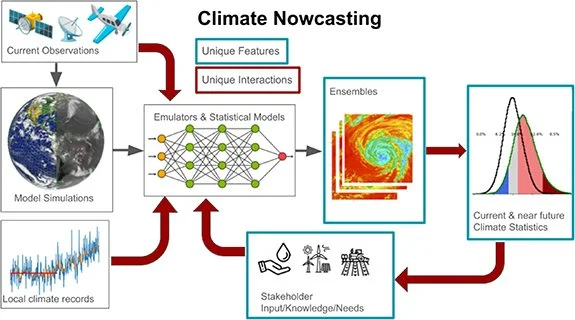
Figure 1: This diagram shows how climate nowcasting uses models, observations and machine learning to create near-future extreme-event scenarios, with nowcasting-specific elements highlighted in red and blue.
A Symphony of Data and Models
Climate nowcasting is not a single approach or data set. This new approach happens through sophisticated data fusion: aggregating different sources of information from simulations, observations and data driven methods to define the most likely set of future conditions, taking advantage of recent observations and projected changes. Picture it as an orchestra where high-resolution computer models, satellite observations, historical records and artificial intelligence all play together, each contributing their strengths. It would work with stakeholders to produce decision relevant information acknowledging and exposing uncertainties.
Multi-scale modeling tools can simulate conditions down to the local scale, while AI/ML methods can generate large numbers of simulated climate futures much more computationally efficiently than traditional simulations. These can be combined with historical and real-time data for analysis to predict the rate and severity of "unprecedented extremes," the ones that keep surprising us, such as the floods, droughts and heat waves that fall outside historical experience.
Real-World Applications Taking Shape
The insurance industry is already hungry for this information. Catastrophe risk modeling for the insurance industry has relied on historical records but now needs to account for changing conditions, recognizing that 'nowcasting' current risks is critical for their risk models. Energy grid operators face similar challenges, needing to predict not just peak demand during heat waves but also supply disruptions from compound extremes like calm and cloudy conditions that dampen renewable energy production.
The vision requires interdisciplinary teams using observations, models and data science methods, working with stakeholders to produce decision-relevant information while acknowledging and exposing uncertainties. Current weather forecasts/predictions and long term climate projections for decades into the future are inadequate for providing this information for society. What is needed is a new approach that focuses on the climate now: climate nowcasting.
The Final Cut: This paper suggests that rapidly changing environmental conditions have rendered historical statistics unreliable for assessing near-term risks, leaving society exposed to extreme events that fall outside past experience. The authors propose climate nowcasting: a new approach that fuses observations, models and AI to provide realistic 10–15 year forecasts of hazard intensity and frequency, filling the critical gap between weather prediction and long-term climate projections.
Thanks for reading this edition of Paper Cuts!
📖 Want to read the full paper from Environmental Research: Climate? Find it here.
📩 Have feedback, questions or suggestions for papers we should cover next? We'd love to hear from you at papercuts@silverlining.ngo.