
007 | Could Brighter Clouds Provide Regional Cooling? A Multi-Model Arctic Investigation
Welcome to Paper Cuts, a series from SilverLining that breaks down timely, peer-reviewed research advancing our understanding of the atmosphere and Earth system. In each edition, we provide a plain-language summary of a recent scientific publication from our grantees, partners or the broader research community, describing why the findings matter and how they contribute to atmospheric and climate science. Subscribe to get each new summary when it's published.
Could Brighter Clouds Provide Regional Cooling? A Multi-Model Arctic Investigation
📘 Summary of: "Marine Cloud Brightening to Cool the Arctic: An Earth System Model Comparison" from Earth's Future, by Matthew Henry , Haruki Hirasawa , Jim Haywood and Philip Rasch.
The Arctic is warming nearly four times faster than the rest of the planet. As ice melts and dark ocean replaces bright white surfaces, the region absorbs more sunlight instead of reflecting it away, kicking off a self-reinforcing cycle that accelerates warming. Scientists have recently begun to consider whether deliberately brightening clouds over polar waters could slow or even prevent this process. A new study in Earth's Future provides the first comprehensive study of this idea using three independent supercomputer simulations of Earth's systems.
Researchers injected virtual sea-salt particles into the atmosphere above northern oceans in these models. The tiny droplets act as seeds for water vapor, creating clouds with more (but smaller) water droplets. These modified clouds reflect more sunlight back to space, much like how a thick fog appears brighter than a thin mist, and having smaller droplets can make the clouds last longer, further increasing sunlight reflection. The question is: could this cooling effect preserve Arctic sea ice as greenhouse gases continue to warm the atmosphere? And, since previous research has suggested that a large cooling effect in one region could have effects elsewhere, would brightening clouds only in the Arctic have unintended impacts on other parts of the planet?
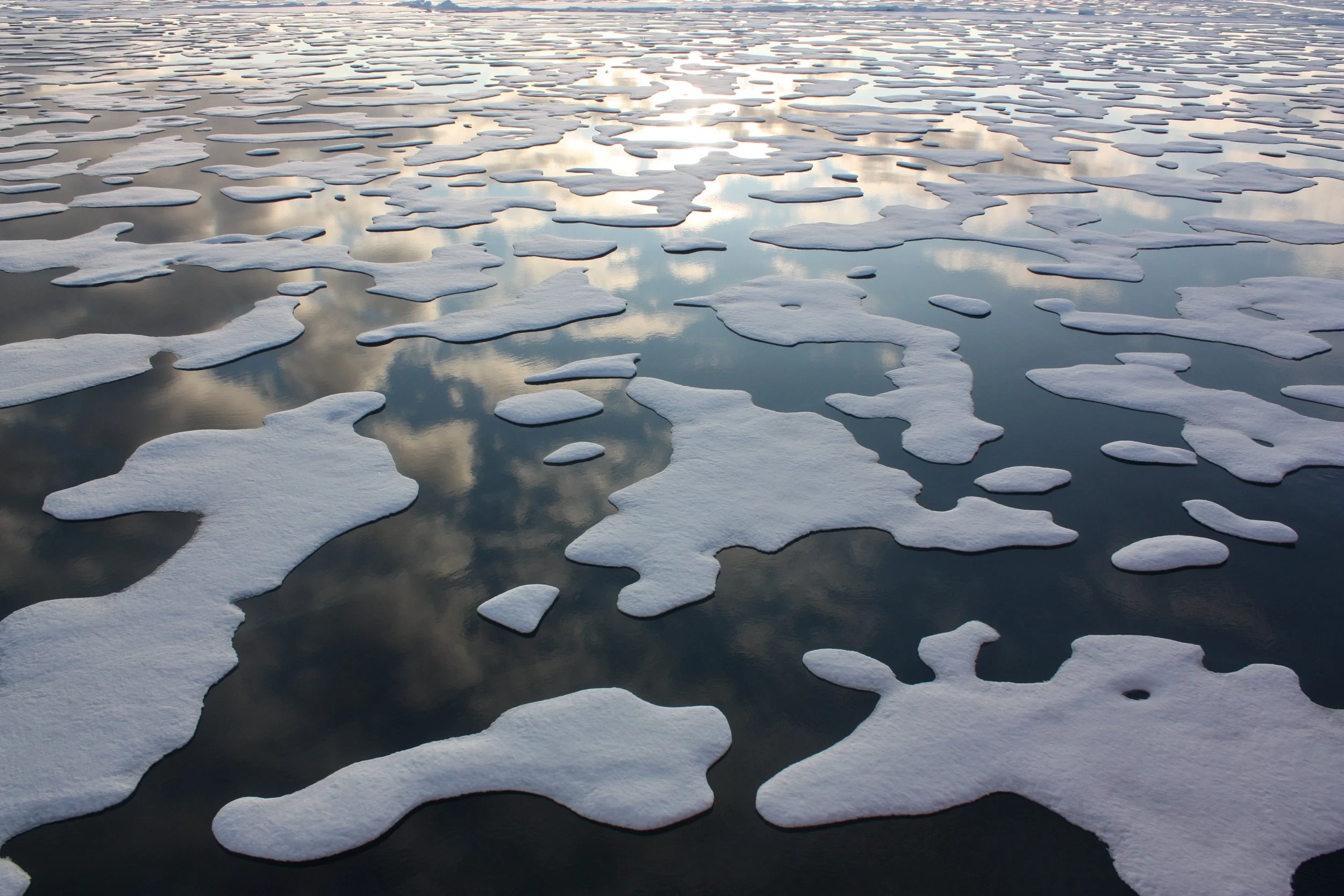
The potential to preserve Arctic sea ice was a question explored by this new modeling study. Credit: NASA
Cross-Model Agreement on Cooling
The research team ran simulations with the UK Earth System Model (UKESM), the Community Earth System Model (CESM) and the Energy Exascale Earth System Model (E3SM), three of the world's most sophisticated tools for understanding planetary processes. Each model independently confirmed that sea-salt injection between 60°N and 80°N can substantially cool the Arctic through enhanced cloud reflectivity.
The simulations assumed a moderate greenhouse gas emissions pathway (SSP2-4.5) with a gradually increasing continuous dispersal of sea salt into the cloud layer targeted to maintain Arctic temperatures near present-day levels. Despite the dramatic difference in sunlight across seasons in the Arctic, there was enough open water and sunlight in the summer for the brightened clouds to cool the Arctic by several degrees.
Maintaining Sea Ice
All three models projected the maintenance of Arctic sea ice cover under this approach. As greenhouse gases accumulated in the simulated atmosphere, the brightened clouds countered the warming effect, preventing the ice loss that would otherwise occur. This finding represents the first time multiple Earth system models have agreed on the potential for cloud brightening to preserve polar ice. However, there remain differences in how each model represents factors controlling Arctic clouds and, in particular, the complex interactions between these clouds and atmospheric particles, since these processes that occur at scales much smaller than the model grid can directly simulate. Thus, despite the good model agreement on the response to cloud brightening in the Arctic, there remain important uncertainties about whether clouds in this region really can be effectively brightened.
Small Responses Outside the Poles
The researchers had anticipated a significant side effect: cooling one hemisphere typically disrupts rainfall patterns in the tropics, potentially shifting monsoons or altering storm tracks. Yet the models showed no robust precipitation changes outside the Arctic. This surprising result suggests that the cooling pattern from Arctic cloud brightening may be more geographically contained than previously thought, though the researchers note this finding requires further investigation.
The Atlantic Meridional Overturning Circulation, the ocean conveyor belt that carries warm water northward and cold water southward, is also partially stabilized in the simulations. However, the team cautions that current models may not fully capture all processes governing this circulation, particularly the effects of freshwater from melting of the Greenland ice sheet
The Measurement Challenge
This research found that, in model simulations, clouds over the Arctic ocean brightened with MCB could preserve sea ice with few knock-on effects on weather and climate elsewhere. In turn, these results provide new motivation for understanding whether clouds in the Arctic could effectively be brightened through the injection of sea salt aerosols. Answering this question will require studies using other types of models, designed to study how clouds respond to aerosols, and expanded observations in the Arctic. Currently, we lack the needed observations to resolve significant uncertainties about how aerosols would actually influence cloud properties in polar regions.
The research also underscores the need for improved monitoring of sea-ice thickness, ocean salinity patterns and atmospheric aerosol distributions throughout the polar regions, data that would enable scientists to validate and refine their representations of these interconnected systems.
What Was Found and What Comes Next
This first multi-model comparison establishes that cloud brightening could theoretically preserve Arctic ice. Strikingly, and unlike findings for other interventions modeled only at northern latitudes, brightening these clouds in the Arctic alone did not have significant negative effects on temperature and precipitation elsewhere. The next science question to be addressed? The practical requirements: whether, when and how the right clouds in the Arctic could actually be brightened. Much remains to be understood about the intricate dance between particles, droplets and light in polar atmospheres.
Final Cut: The Arctic is warming nearly four times faster than the global average, accelerating sea-ice loss through increased sunlight absorption. This study tests whether deliberately brightening clouds over Arctic oceans could counteract this warming by reflecting more sunlight back to space. Using three independent Earth system models, the results show that, with certain assumptions about cloud brightening processes, cloud brightening could preserve Arctic sea ice under continued greenhouse gas emissions without some previously assumed negative effects on temperature and precipitation elsewhere, indicating that further research on this topic may be valuable.
Thanks for reading this edition of Paper Cuts!
📖 Want to read the full paper from Earth's Future? Find it here.
📩 Have feedback, questions or suggestions for papers we should cover next? We'd love to hear from you at papercuts@silverlining.ngo.