
008 | A Framework for Sunlight Reflection Field Research
Welcome to Paper Cuts, a series from SilverLining that breaks down timely, peer-reviewed research advancing our understanding of the atmosphere and Earth system. In each edition, we provide a plain-language summary of a recent scientific publication from our grantees, partners or the broader research community, describing why the findings matter and how they contribute to atmospheric and climate science. Subscribe to get each new summary when it's published.
A Framework for Sunlight Reflection Field Research
📘 Summary of: "Defining Scales of Field Studies and Experiments to Assess Marine Cloud Brightening"from AGU Advances, Volume 7 - 2026, by Sarah Doherty, Michael Diamond, Robert Wood and Haruki Hirasawa.
The Challenge: Reducing Uncertainty Through Small-Scale Field Studies
To understand the safety, risks and possible benefits of intentionally reflecting more sunlight from the atmosphere and clouds, scientists need a better grasp of the many local and small-scale processes that drive these effects. Field studies that observe these processes are essential for testing and improving the computer models used to study these approaches and ultimately for producing better projections of how sunlight reflection, or solar radiation management (SRM), would play out in the real world.
Where Current Models Are Lacking
Most of what scientists currently understand about SRM's potential benefits and risks comes from computer modeling studies, which carry known, and potentially some unknown, sources of error. Climate models are powerful tools, but they are ultimately simplified representations of an extraordinarily complex atmosphere. And therein lies a critical challenge: some of the processes most critical to SRM, like how clouds form and respond to particles, remain particularly difficult to simulate with confidence.
Well-designed field studies involving the release of relatively small quantities of aerosols could provide substantially more robust information, grounding our understanding and models in direct observations of the real atmosphere.
But how do you design such experiments to meaningfully advance scientific understanding while demonstrating, rigorously and transparently, that they fall nowhere near the scale required to alter weather or climate?
The Solution: A Framework for SRM Field Research Based on Scale and Impact
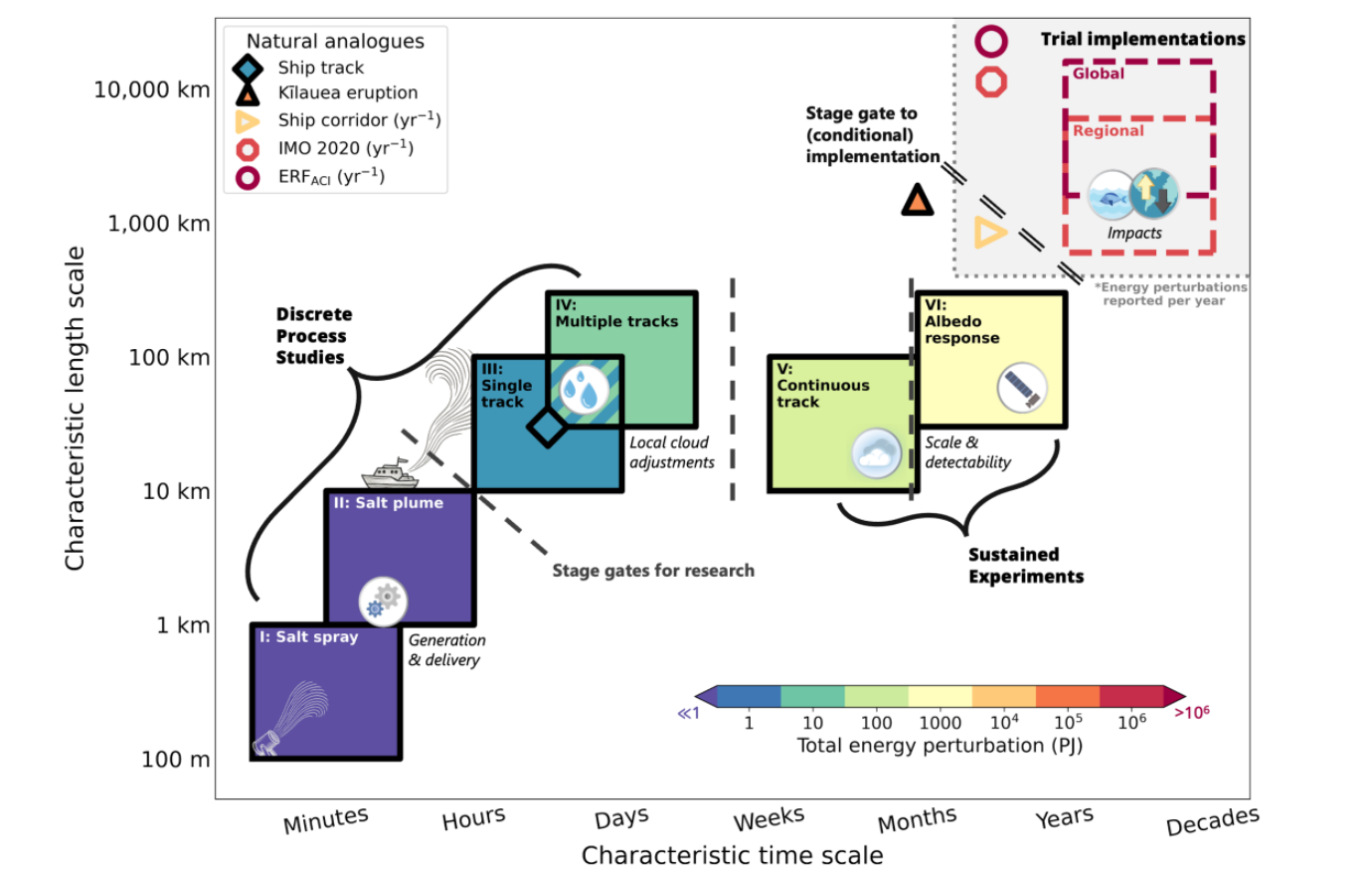
Proposed framework for defining scales of SRM field studies, as applied to the case of marine cloud brightening.
A team of researchers led by Dr. Sarah Doherty at the University of Washington has proposed a framework for defining different scales of SRM field experiments, applying it to marine cloud brightening (MCB): an approach that involves spraying sea salt particles into select ocean cloud regions to increase their reflectivity.
The framework organizes MCB field experiments into six escalating stages, each with specific goals, measurable outcomes and defined protective limits. Each stage is benchmarked against already occurring analogs,such as aerosols from ship emissions or volcanic eruptions,to provide additional context. Critically, the framework establishes clear stage-gates: decision points at which findings from smaller-scale studies inform whether and how to proceed to the next scale, weighing scientific value alongside physical and social risks.
A key feature is that it allows field studies to be evaluated in quantifiable terms across both their scientific value and potential impacts, physical and social. While the paper focuses on MCB, the framework is designed to be applied across other SRM approaches, enabling similarly grounded assessment of specific field experiments.
From Single Tracks to Possible Regional Experiments
The paper describes scientific studies designed to improve the assessment of MCB in the context of the framework, including what information is likely to be gained at each scale to inform decisions about the potential for MCB to reduce climate risks and impacts. The same approach can be extended to other SRM approaches to inform future societal decisions regarding SRM use.
Stage I involves studying how sea salt particles behave right after leaving the source, tracking them for just a few hundred meters downwind, with the goal of improving models of how they disperse in the atmosphere.
Stage II extends this to a few kilometers, examining how particles spread and evolve on their way to mixing into clouds.
Stage III studies involve creating a single, intermittent sea salt plume to influence a cloud, or ‘ship track,’ mimicking the brightened lines of clouds sometimes produced by the aerosol pollution particles from cargo ships. In this case, the sea salt ‘tracks’ would last just a few hours, allowing precise study of the sea salt plume and how clouds respond to the added particles.
Stage IV involves creating multiple sea-salt plumes simultaneously to examine how they interact.
Stage V maintains a single track continuously over weeks or months to gather statistics across varying hyperlocal weather conditions.
Stage VI extends multiple plumes over a region roughly 100 kilometers by 100 kilometers: studies intended to be undertaken only after careful evaluation of scientific benefits and environmental and other risks.
Establishing Clear Safety Boundaries
The researchers combined theoretical analysis, computer modeling and observations of MCB analogs in the current atmosphere to identify where the line falls between activities with little to no environmental impact focused on scientific learning and the scale of activity that would affect weather or climate and constitute SRM implementation. Their analysis shows that producing detectable temperature changes would require operations across vast areas sustained far longer than any of the experiments described.
A crucial safety feature of the framework is that even the largest study described, Stage VI, is designed to remain below the threshold of measurably affecting regional or global temperature or weather patterns, while still delivering robust scientific information.
The framework does not directly address implementation at larger scales intended to change weather or climate. Rather, it shows how stepwise experiments at progressively larger scales can build predictive understanding of SRM deployment impacts. Findings from these studies would also form a critical foundation for the monitoring systems that safe and responsible implementation would require.
This distinction matters for both scientists and policymakers. By providing a clear research pathway while establishing firm boundaries between learning about cloud brightening and implementing it, the framework gives both groups something they have lacked: a shared, evidence-based reference point for decision-making.
Why This Matters Now
As debate continues over whether and under what conditions SRM field experiments should proceed, this SRM field research framework offers a science-based path forward. By categorizing field research activities according to their physical impacts and the state of scientific knowledge, it brings clearer structure to a genuinely consequential decision-making challenge.
The Final Cut: A new framework from University of Washington and Florida State University researchers offers a concrete approach to assessing the scientific value and safety of field research in reflecting sunlight from the atmosphere. By defining quantifiable boundaries between activities, from those with minimal impact to those affecting weather or climate, it establishes clear categories of scale, with explicit limits and decision points for moving from smaller to larger studies.
This is an important step in enabling scientists to advance knowledge while managing risk, and gives broader society a clearer frame of reference for informed decision-making about these activities.
Thanks for reading this edition of Paper Cuts!
📖 Want to read the full paper from AGU Advances? Find it here.
📩 Have feedback, questions or suggestions for papers we should cover next? We'd love to hear from you at papercuts@silverlining.ngo.