
010 | Can Particles Added to the Stratosphere Be Effectively Removed?
Welcome to Paper Cuts, a series from SilverLining that breaks down timely, peer-reviewed research advancing our understanding of the atmosphere and Earth system. In each edition, we provide a plain-language summary of a recent scientific publication from our grantees, partners or the broader research community, describing why the findings matter and how they contribute to atmospheric and climate science. Subscribe to get each new summary when it's published.
📘 Summary of: "Efficacy Assessment of Stratospheric Aerosol Scrubbing as a Counter Climate Intervention Strategy" from European Geosciences Union (EGU) Atmospheric Chemistry and Physics, Volume 26 - 2026, by Dr. Anthony Jones, Jim Haywood, Matthew Henry, and Alistair Duffey
Can Particles Added to the Stratosphere Be Effectively Removed?
For decades, scientists have studied what might happen if particles were deliberately added to the stratosphere to reflect a fraction of sunlight back into space to cool the climate. But a new study asked a different question: if one actor injects those particles could a different actor – for either adversarial or cooperative reasons – effectively remove them?
In a paper published by researchers at the University of Exeter and collaborators, scientists tested a concept they call “Stratospheric Aerosol Scrubbing,” or SAS. Using advanced atmospheric simulations, they examined whether larger mineral particles could induce existing aerosol particles to clump together, grow heavier and fall out of the upper atmosphere faster.
The research objectives have some similarities to cleaning systems in smokestacks known as scrubbers, and the authors therefore coined the phrase 'Stratospheric Aerosol Scrubbing'. In smokestacks, particles are captured and removed before they spread into the air. The researchers wanted to know whether something analogous could happen in the stratosphere.
Following the Life of a Particle
The study focused on sulfur-based aerosols, the same type of particles produced naturally during major volcanic eruptions. After eruptions like Mount Pinatubo in 1991, these particles spread through the stratosphere and reflected incoming sunlight away from Earth for months to years. Deliberate stratospheric aerosol injection seeks to replicate this natural cooling effect on demand.
But particle size matters enormously. Very small particles remain suspended for long periods and are highly effective at scattering sunlight. Larger particles behave differently. They are less reflective, absorb more heat and settle downward more quickly under gravity.
That distinction became the foundation of the new experiments. The researchers simulated what would happen if coarse calcite particles, a mineral commonly found in limestone and chalk, were added to the same region as sulfate aerosols produced from intentional dispersal of sulfur dioxide gas. Their hypothesis was that the calcite could act as a kind of gathering point, encouraging sulfate particles to condense onto larger surfaces and grow beyond their most reflective size. Once enlarged, the particles would become heavier and fall out of the stratosphere faster.
Testing the Atmosphere in a Virtual World
To explore the idea, the team used a next-generation atmospheric model capable of tracking how aerosols form, grow, collide and move through the atmosphere. The scientists ran two main sets of experiments. The first simulated short “pulse” events lasting two months, while the second simulated continuous particle dispersion lasting twenty years, representing a more sustained atmospheric intervention.
Across both scenarios, the results pointed in the same direction. Where calcite particles were introduced alongside sulfur dioxide, the total amount of reflective aerosol in the stratosphere dropped by roughly 30–40 percent compared to simulations without scrubbing particles. The simulations showed that the added calcite encouraged sulfuric particles to grow larger and settle out of the atmosphere more rapidly.
Size Changed Everything
One of the study’s clearest findings was that effectiveness depended heavily on particle size. Calcite particles around 0.5 micrometers in diameter produced the strongest reduction in atmospheric aerosol levels. Smaller particles actually had the opposite effect in some simulations, behaving more like reflective aerosols themselves rather than helping remove them. Timing also mattered: When the calcite was released immediately alongside sulfur dioxide, the effect was strongest. Delaying the release by just one month noticeably weakened the scrubbing effect.
Location mattered as well. Simulations where the two materials were released close together produced stronger effects than cases where they were introduced on opposite sides of the planet. Together, these results highlight how sensitive the upper atmosphere can be to the details of particle behavior: not only what is released, but when, where, and in what form.
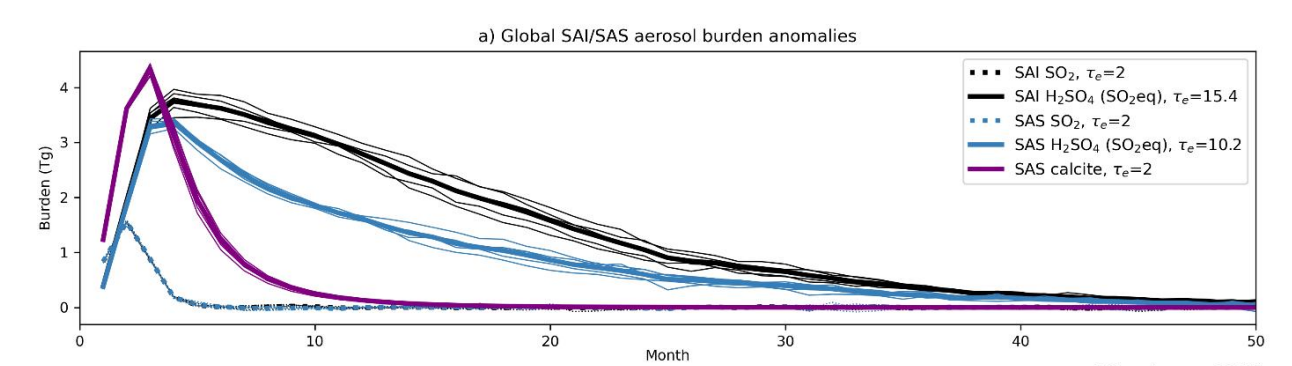
Figure 1: Simulations from the study show that when calcite particles (purple) were added alongside sulfur aerosols, the total aerosol burden in the stratosphere declined much more rapidly than in simulations without calcite (blue), as particles clumped together, grew heavier and fell out of the atmosphere faster. (Credit: Jones et al., 2026)
What Scientists Still Need to Learn
The researchers are careful throughout the paper to emphasize that these are early simulations, not real-world tests. The atmosphere is enormously complex and many important chemical interactions remain uncertain.
For example, the model used in the study does not fully represent the numerous ways calcite particles interact with ozone chemistry in the stratosphere. The authors note that future studies will need more advanced chemistry models, more detailed particle physics, and additional laboratory experiments.
The paper also highlights the importance of atmospheric observations. Understanding how particles grow, move and settle in the real stratosphere requires precise measurements over long periods of time. Volcanic eruptions provide some natural comparisons, but there are still major gaps in direct observations of aerosol behavior in the stratosphere.
A Window Into Atmospheric Processes
One of the most interesting aspects of the study is that it focuses less on controlling temperature and more on understanding atmospheric processes themselves.
The researchers explored how particles evolve once they enter the stratosphere, how they interact with one another, and how their physical properties shape their lifetime in the atmosphere. Their simulations suggest that introducing larger particles can alter those lifetimes significantly.
The Final Cut: For years, scientists have studied what might happen if reflective particles were added to the stratosphere. This study explored the reverse question: could those particles later be effectively removed? Using atmospheric simulations, researchers found that introducing larger mineral particles could reduce stratospheric aerosol levels by roughly 30–40% by causing particles to coalesce and fall out of the atmosphere more quickly.
Thanks for reading this edition of Paper Cuts!
📖 Want to read the full paper from EGU Atmospheric Chemistry and Physics? Find it here.
📩 Have feedback, questions or suggestions for papers we should cover next? We'd love to hear from you at papercuts@silverlining.ngo.