
009 | Engineering a Particle for the Stratosphere
Welcome to Paper Cuts, a series from SilverLining that breaks down timely, peer-reviewed research advancing our understanding of the atmosphere and Earth system. In each edition, we provide a plain-language summary of a recent scientific publication from our grantees, partners or the broader research community, describing why the findings matter and how they contribute to atmospheric and climate science. Subscribe to get each new summary when it's published.
📘 Summary of: "Engineering amorphous silica particles to reduce the uptake behavior for stratospheric aerosol injection"by Tzemah K., Alina Berkman, Gal Schwartz Roitman, Kariene Neiman, Anaïs Lostier, Subhadarsi Nayak, Amir Goldbourt, David Avnir , and Manolis Romanias
Engineering a Particle for the Stratosphere
Stratospheric aerosol injection (SAI) — the deliberate introduction of tiny particles into the upper atmosphere to reflect a portion of sunlight and reduce warming — has been studied as a potential response to climate risk, though whether it will ever be necessary or justified remains a live debate. One of the core scientific challenges is understanding how those particles would behave chemically once suspended in the stratosphere — a question that matters enormously, since particles can remain at altitude for months or years and interact with the chemistry around them in ways that are difficult to predict or reverse.
When scientists think about particles in the upper atmosphere, size is only part of the story; the surface matters too. Every particle suspended high above Earth effectively becomes a tiny floating surface that surrounding gases can interact with. Some molecules bounce away immediately; others attach to the surface or trigger chemical reactions that would otherwise happen much more slowly. In the stratosphere, where the chemistry of ozone — the layer that shields Earth from ultraviolet radiation — is particularly sensitive, those surface interactions become especially consequential.
A new study explores whether particles can be deliberately engineered to reduce those interactions from the outset. Rather than searching only for materials that reflect sunlight effectively, the researchers also examined a broader set of challenges surrounding particles suitable for SAI: how they might interact chemically with the atmosphere, how realistically they could be manufactured at scale, and how safely they might behave once they eventually settle back out of the stratosphere.
The team explored these questions through a combination of theoretical analysis and targeted laboratory experiments on specially engineered silica particles: tiny spherical particles designed to reduce how strongly important atmospheric gases attach to their surfaces. While the laboratory work focused on a limited set of gases and controlled conditions, the paper also considers how these engineered surfaces may interact with additional atmospheric compounds and evolve over time in the stratosphere.
Why Surfaces Matter in the Stratosphere
Scientists have long known that particle surfaces can shape atmospheric chemistry, and major volcanic eruptions provide one well-known example. After the eruption of Mount Pinatubo in 1991, sulfur-rich particles spread through the stratosphere and remained there for extended periods. Those particles reflected sunlight, but they also changed the chemical environment around them. Certain gases in the stratosphere can temporarily stick to particle surfaces, where they may react differently than they would in open air. Scientists have learned over decades of atmospheric research that these surface reactions can influence ozone chemistry.
That dual role presents a challenge for any proposed atmospheric particle system. A particle might be excellent at reflecting sunlight while also acting like a tiny chemical platform where gases gather and react. That creates a difficult balancing act: a material that works well physically may also interfere with important atmospheric chemistry. Experiments have shown that previously studied materials, including sulfate aerosols, alumina, and carbonate-based particles, can interact significantly with gases such as hydrochloric acid and nitrogen compounds under stratospheric conditions.
This study approached the problem differently. Instead of beginning with naturally occurring minerals, the researchers engineered particles specifically intended to minimize gas-surface interactions. Their goal was not simply to find a suitable material, but to shape the particle surface itself.
Building a Different Kind of Particle
The research team chose amorphous silica (a non-crystalline form of silicon dioxide) as their starting point. Unlike crystalline quartz, which is made up of silica but has known inhalation risks, amorphous silica has a substantially stronger safety profile and can be modified more easily at the surface level. Using a controlled chemical process, the researchers produced highly uniform spherical particles roughly 250–500 nanometers in diameter. For comparison, a human hair is typically around 80,000–100,000 nanometers in diameter. The particles were then heated to very high temperatures, which smoothed and densified their surfaces and reduced the number of locations where gases could easily attach.
Afterward, the team coated the particle surfaces with water-repelling molecular structures attached directly to the silica surface. The goal was to make the particles less chemically attractive to surrounding gases. In effect, the researchers were redesigning the outermost layer of the particle: the part that actually comes into contact with the atmosphere.
The resulting particles behaved very differently from untreated silica. Water droplets placed on the engineered surfaces formed nearly spherical beads instead of spreading outward, much like rain beading up on a waterproof jacket. Contact angle measurements showed a dramatic shift from fully wettable surfaces to strongly water-repelling ones. The particles also remained remarkably stable; the study exposed them to ultraviolet radiation designed to approximate roughly a year of stratospheric exposure, as well as vapors of hydrochloric and nitric acid. Even after those harsh tests, the modified surfaces largely retained their structure and water-repelling properties.
Testing the Particle in a Lab Version of the Stratosphere
Once the particles were prepared, the researchers examined how they interacted with several gases important to stratospheric chemistry: hydrochloric acid (HCl), nitric acid (HNO3), dinitrogen pentoxide (N2O5), and ozone (O3). The experiments took place at temperatures near 220–225 Kelvin, similar to conditions in the lower stratosphere. Using specialized low-temperature and pressure laboratory chambers designed to mimic stratospheric conditions, the researchers exposed the particles to different gases and measured how many molecules attached to the surface, how strongly they attached and whether they later detached again.
Across nearly every test, the engineered particles showed weaker interactions than quartz. For hydrochloric acid, the engineered particles absorbed roughly ten times less gas than quartz surfaces. The other gases described above also showed substantially reduced uptake. In many cases, gas molecules only lingered briefly on the engineered particles before drifting away again. That suggests the particles were not strongly encouraging ongoing chemical reactions at their surfaces; rather, many of the interactions were weak and reversible.
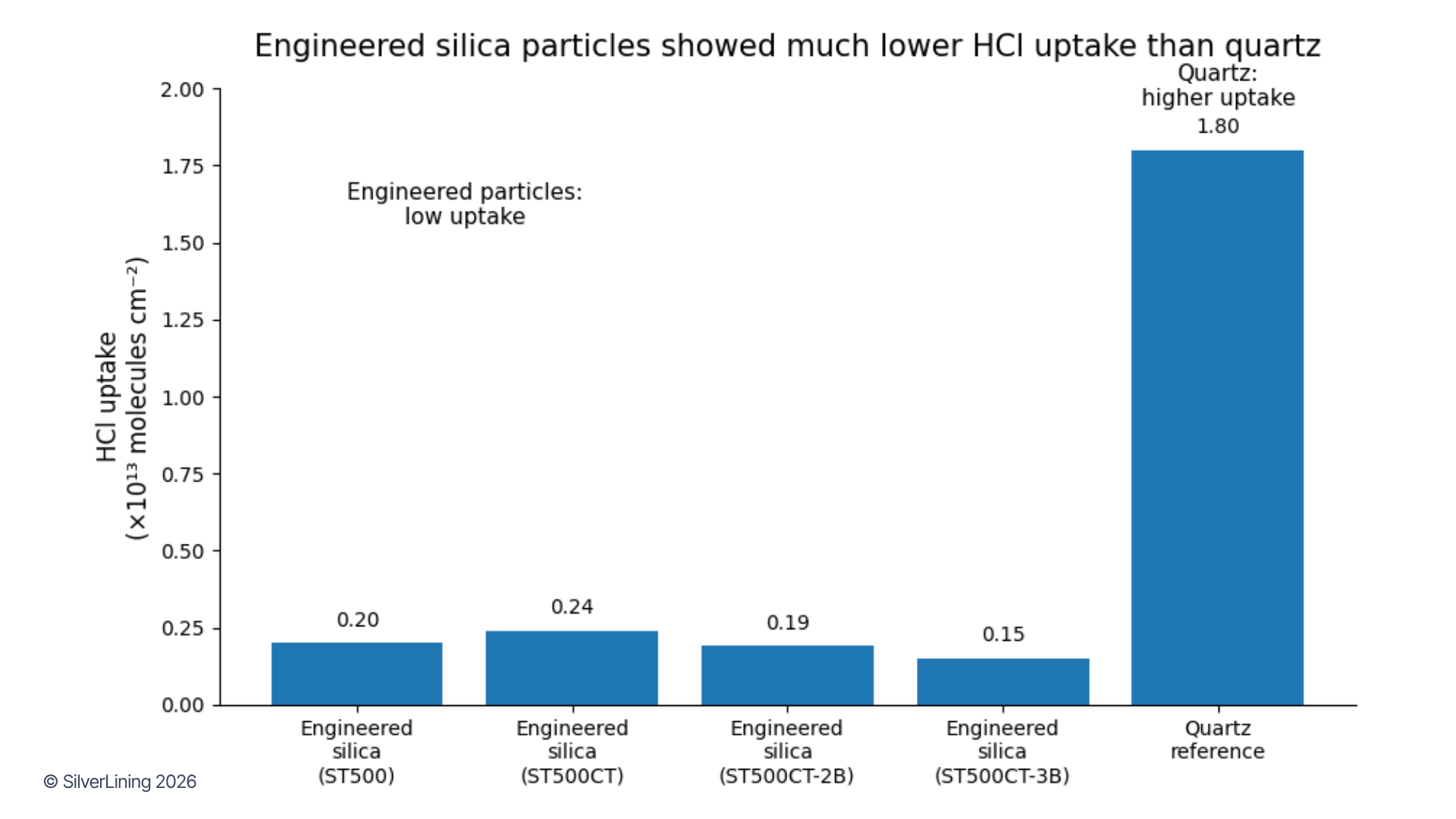
Figure 1: These experiments compared how strongly different particles interacted with atmospheric gases. The engineered silica particles consistently showed lower gas uptake than quartz, suggesting that carefully designed surfaces may reduce unwanted chemical reactions in the stratosphere. Credit: SilverLining.
Ozone interactions were even smaller. Measured ozone uptake remained near experimental detection limits across all tested materials, reinforcing the conclusion that the engineered surfaces interacted only weakly with ozone under the tested conditions.
One of the clearest patterns involved how water-repelling the particles were. As the particle surfaces became more water-repelling, they generally interacted less with surrounding gases. The findings suggest that changing the outermost molecular layer of a particle can substantially alter how it behaves in the atmosphere.
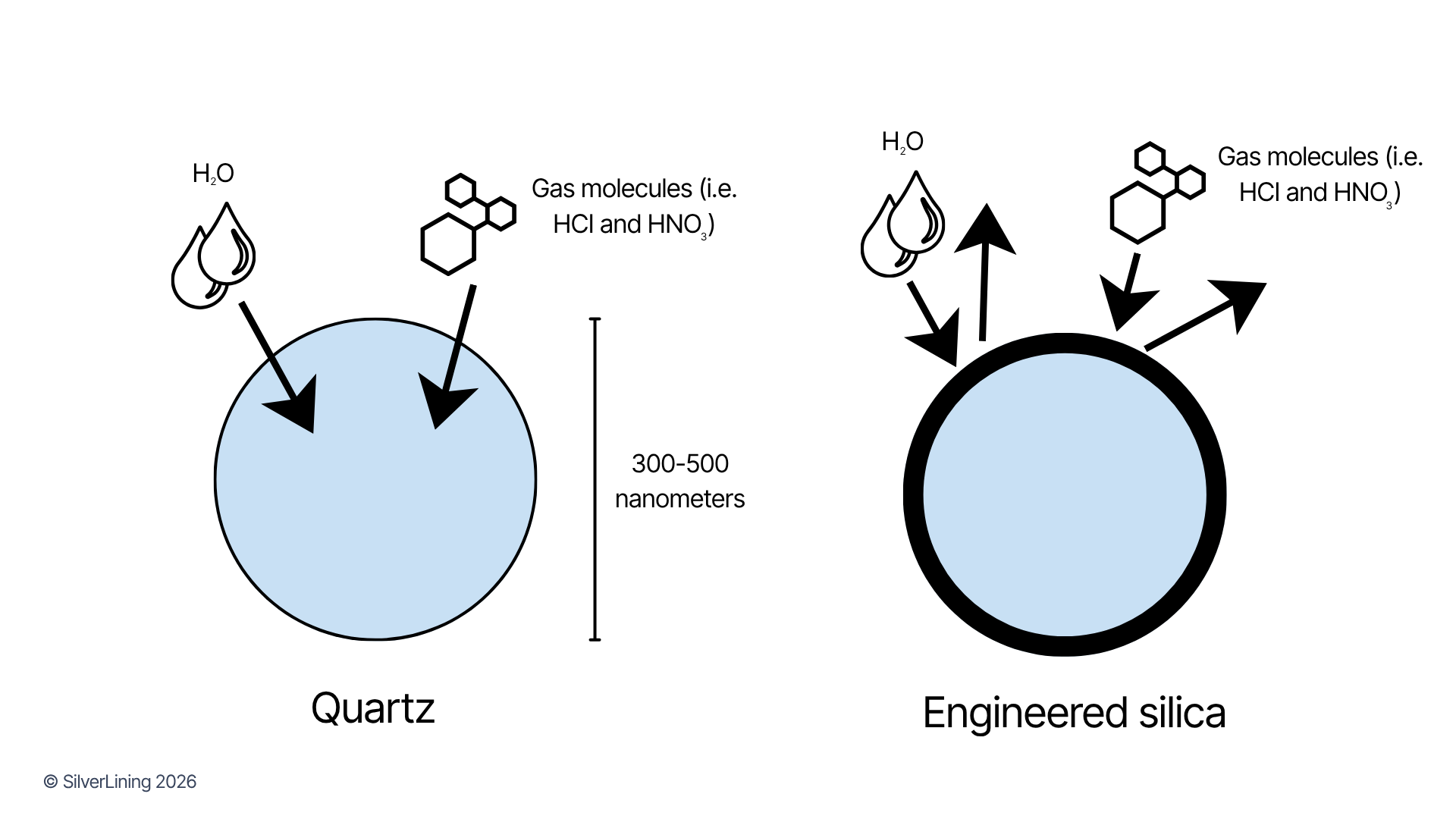
Figure 2: Simplified schematic illustrating the central finding of the study. On untreated quartz-like surfaces (left), water and atmospheric gases can interact more readily with the particle surface. On engineered silica particles with hydrophobic surface modification (right), those interactions are reduced, leading to lower gas uptake in laboratory experiments. Credit: SilverLining.
The Challenges of Engineered Atmospheric Materials
One of the most interesting aspects of the paper is its broader design philosophy. Historically, many particles proposed for use in SAI have been borrowed directly from naturally occurring materials. This study approaches atmospheric particles less like naturally occurring dust and more like engineered materials whose behavior can be carefully designed in advance. Surface chemistry, stability and interaction with surrounding gases become design parameters rather than afterthoughts. The authors describe this as a “chemistry-constrained” and “safety-by-design” approach. In practice, that means considering not only how a particle scatters light, but also how it behaves chemically over time in the stratosphere.
At the same time, the paper remains careful about uncertainty. The experiments were conducted under controlled laboratory conditions designed to isolate specific gas–surface interactions at low temperatures relevant to the lower stratosphere. While the engineered coatings remained stable during simulated UV exposure and exposure to acidic vapors, the researchers note that the real stratosphere is far more complex. Questions surrounding long-term particle evolution, large-scale atmospheric transport, aerosol dispersion, coating behavior over extended timescales, and interactions with additional atmospheric compounds are still largely unanswered.
The authors likewise note that viable stratospheric particles would ultimately need to satisfy far more than chemical compatibility alone. Radiative performance, atmospheric transport, manufacturability, environmental stability, and broader safety-related constraints would all need to be considered together.
The study nevertheless highlights that atmospheric particles can be deliberately engineered to change how they interact with surrounding gases. The work points toward a shift in how future particles for use in SAI may be designed not only for optical performance, but also for chemical stability, controllability, safety for humans and the environment, and reduced interaction with ozone-relevant atmospheric chemistry from the very beginning.
The Final Cut: This study explored whether specially engineered silica particles could be designed to interact less strongly with gases in the stratosphere. Using targeted laboratory experiments that simulated upper-atmosphere conditions, the researchers found that water-repelling surface coatings substantially reduced how strongly several ozone-relevant gases attached to the particles.
The study also considered broader questions around manufacturability, environmental behavior and particle stability, though many of these conclusions remain theoretical and were not tested experimentally. The findings suggest that future SAI particles may be engineered not only for physical performance, but also to reduce unwanted chemical interactions over time.
Thanks for reading this edition of Paper Cuts!
📖 Want to read the full paper? Find it here.
📩 Have feedback, questions or suggestions for papers we should cover next? We'd love to hear from you at papercuts@silverlining.ngo.